
Introduction
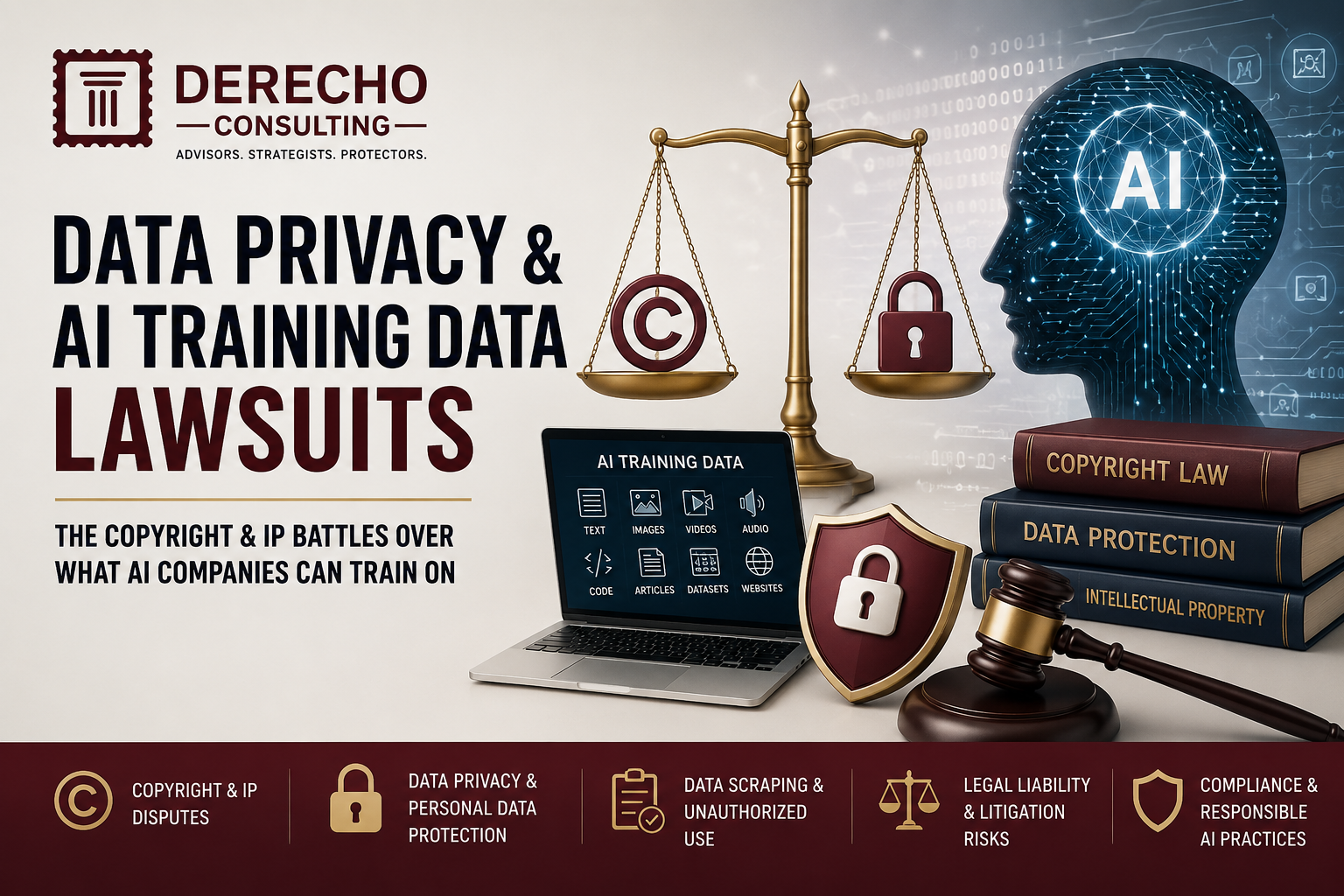
AI Training Data Lawsuits have become an important legal issue as artificial intelligence companies increasingly rely on large volumes of online content, copyrighted works, personal information, and other datasets to develop and train AI models. The growing use of books, news articles, images, websites, and other digital content for AI training has raised difficult questions about copyright, data privacy, licensing, consent, ownership, and legal liability.
The issue is particularly relevant in India following the Delhi High Court’s July 2026 decision in ANI Media Pvt. Ltd. v. OpenAI OpCo LLC, which considered whether the use and storage of copyrighted news content for training large language models could fall within the fair-dealing framework under the Copyright Act, 1957. The Court declined to grant ANI an interim injunction against OpenAI, making the case an important development in India’s emerging AI and copyright landscape.
At the same time, AI training-data litigation continues internationally. Publishers, authors, and other copyright owners have brought lawsuits alleging that AI companies used copyrighted material to train their models without appropriate permission or licensing. A recent 2026 example is the lawsuit filed by WikiHow against OpenAI concerning the alleged use of its articles for AI training.
This guide explains Data Privacy & AI Training Data Lawsuits, including copyright concerns, privacy risks, training-data collection, licensing, consent, AI-generated outputs, litigation exposure, and practical compliance considerations for businesses developing or using AI systems.
Why AI Training Data Lawsuits Matter
AI systems depend heavily on data, making the source, ownership, legality, and permitted use of training data important legal considerations.
AI training-data disputes can involve:
- Copyright infringement claims.
- Unauthorised copying or storage of protected works.
- Data privacy concerns.
- Use of personal information.
- Lack of consent or lawful basis.
- Unlicensed datasets.
- Data scraping.
- Reproduction of protected content through AI outputs.
- Commercial use of copyrighted material.
- Cross-border data and jurisdictional issues.
For businesses, understanding these risks can help prevent costly disputes and support responsible AI development and deployment.
Key Legal Issues in AI Training Data
1. Copyright and AI Training Data
Copyright is one of the central legal issues surrounding AI training.
AI developers may collect and process large quantities of text, images, books, news articles, software code, and other protected material. The legal question is whether such use requires authorisation or can fall within an applicable copyright exception.
India’s 2026 ANI Media v. OpenAI ruling has brought this issue directly before Indian courts. The Delhi High Court considered the relationship between AI training, copyright protection, and the fair-dealing exception under Section 52 of the Copyright Act, 1957.
However, businesses should not assume that the ruling provides a blanket permission to use all copyrighted material for AI training. The legal position remains fact-specific and subject to further judicial developments.
2. Data Scraping and Collection
AI companies may obtain training information through websites, publicly accessible databases, licensed datasets, user-generated content, and other sources.
Businesses should evaluate:
- Where the data originated.
- Whether the data was publicly accessible.
- Whether access was authorised.
- Whether contractual restrictions apply.
- Whether the material is copyright-protected.
- Whether personal information is included.
- Whether the data can legally be processed for the intended purpose.
The fact that information is available online does not automatically resolve every copyright, contractual, or privacy question.
3. Privacy and Personal Data
Training datasets may contain personal information relating to individuals.
This creates additional compliance considerations concerning:
- Collection of personal data.
- Purpose of processing.
- Lawful processing.
- Consent where applicable.
- Data minimisation.
- Security safeguards.
- Retention.
- Individual rights.
- Cross-border processing.
- Deletion or correction requests.
Companies developing AI systems should therefore assess privacy implications before incorporating large datasets into training pipelines.
4. Licensing and Permission
Where businesses use third-party copyrighted content for AI development, licensing can provide an important mechanism for managing legal risk.
Organisations should consider whether they need appropriate rights for:
- Text.
- Books.
- News content.
- Images.
- Music.
- Video.
- Software code.
- Databases.
- Proprietary business information.
Clear licensing terms can help establish what the AI developer is permitted to collect, store, process, modify, and use.
5. AI Outputs and Copyright Risk
Training-data disputes do not end with the training process.
AI-generated outputs may raise separate questions where a system produces content that substantially reproduces protected material.
Businesses should consider:
- Whether outputs reproduce protected works.
- Whether the output is substantially similar to source material.
- Whether the system can memorise sensitive information.
- Whether users may commercially exploit generated content.
- Whether output-monitoring controls are necessary.
The distinction between training-data use and output-related infringement is therefore important when assessing AI legal risk. The ANI litigation itself involved both training-related and output-related claims.
6. Cross-Border AI Training
AI companies frequently operate across multiple jurisdictions. Data may be collected in one country, processed in another, and used to provide services globally.
This can create questions concerning:
- Territorial jurisdiction.
- Applicable copyright law.
- Data protection requirements.
- Cross-border data transfers.
- Contractual obligations.
- Regulatory investigations.
- Enforcement of foreign judgments.
The ANI case also involved arguments concerning the location of servers and the territorial application of Indian copyright law.
7. Commercial and Confidential Data
Businesses should also consider the risks associated with using confidential corporate information as AI training data.
Sensitive information may include:
- Customer information.
- Trade secrets.
- Proprietary databases.
- Business strategies.
- Financial information.
- Internal communications.
- Source code.
- Contractual information.
Organisations should establish controls to prevent confidential or proprietary information from being incorporated into AI training datasets without appropriate authorisation.
Common Legal Risks
Businesses developing or deploying AI systems may face risks due to:
- Unlicensed training data.
- Unauthorised data scraping.
- Copyright infringement claims.
- Improper processing of personal information.
- Inadequate privacy controls.
- Use of confidential information.
- Unclear data ownership.
- Weak vendor agreements.
- Insufficient dataset documentation.
- Cross-border compliance issues.
- AI outputs reproducing protected content.
- Lack of AI governance procedures.
Best Practices for AI Training Data Compliance
Businesses should consider the following measures:
- Conduct training-data due diligence.
- Maintain a record of dataset sources.
- Identify copyright ownership where possible.
- Review applicable licences and permissions.
- Establish privacy assessments for datasets containing personal information.
- Avoid unnecessary collection of sensitive information.
- Maintain data-provenance documentation.
- Establish contractual safeguards with AI vendors.
- Review data-processing and confidentiality provisions.
- Implement controls for confidential corporate information.
- Monitor AI outputs for potential reproduction of protected material.
- Maintain an AI governance framework.
- Obtain legal advice for high-risk datasets and AI applications.
2026 Legal Considerations
The legal landscape surrounding AI training data is developing rapidly in 2026.
India’s ANI Media v. OpenAI decision is an important development because it directly addresses copyright issues arising from AI model training. However, the decision should be understood in the context of the specific interim proceedings and the particular facts before the Court.
Internationally, copyright holders continue to bring claims against AI developers. For example, publishers and authors filed a 2026 class action against Google concerning alleged use of copyrighted works to train Gemini, while WikiHow filed a separate copyright lawsuit against OpenAI in August 2026.
This makes AI training data compliance an increasingly important consideration for companies developing, procuring, or deploying AI technologies.
How Derecho Consulting Can Help
Derecho Consulting can help businesses assess legal risks associated with AI and training data through technology-law advisory, copyright analysis, privacy and data-protection reviews, contractual assessments, AI governance, regulatory analysis, compliance frameworks, and legal risk management.
A proactive approach to AI Training Data Compliance can help businesses understand data sources, assess copyright and privacy exposure, strengthen contractual protections, and establish appropriate governance processes for responsible AI adoption.
Conclusion
Data Privacy & AI Training Data Lawsuits represent an emerging area where technology, intellectual property, privacy, and corporate compliance increasingly intersect.
Businesses using or developing AI systems should carefully consider where training data comes from, whether appropriate rights exist, whether personal information is involved, how data is stored and processed, and whether AI-generated outputs could create additional legal exposure.
The evolving Indian and international litigation landscape demonstrates that AI training-data questions are no longer purely technical issues. They are becoming important legal, compliance, governance, and risk-management considerations for businesses.
A proactive approach to training-data due diligence, copyright assessment, privacy compliance, licensing, contractual safeguards, and AI governance can help organisations reduce legal uncertainty while supporting responsible AI innovation.