
Introduction
AI Audit is becoming an increasingly important part of responsible artificial intelligence governance as Indian businesses use AI for customer service, recruitment, marketing, financial analysis, software development, decision-making, fraud detection, and other business functions. As AI systems become more integrated into business operations, organisations need practical processes for reviewing how these systems are designed, deployed, monitored, and managed.
An AI audit can help a business examine areas such as data use, security, accuracy, bias, transparency, human oversight, contractual responsibilities, intellectual property, and compliance. However, businesses should distinguish between an AI audit as a governance and risk-management practice and any specific audit or assurance obligation that may arise from sector-specific law, contractual requirements, cybersecurity rules, data-protection obligations, or regulatory directions.
India’s AI policy discussions have emphasised responsibility, accountability, human oversight, impact assessment, monitoring, due diligence, and auditability as important elements of responsible AI. IndiaAI’s responsible-AI material notes that existing laws may address many AI-related harms, while the particular characteristics of AI may require additional attention to accountability and governance.
The Government’s 2026 activity also includes the constitution of an AI Governance and Economic Group (AIGEG) under MeitY, reflecting the continuing development of India’s AI governance ecosystem.
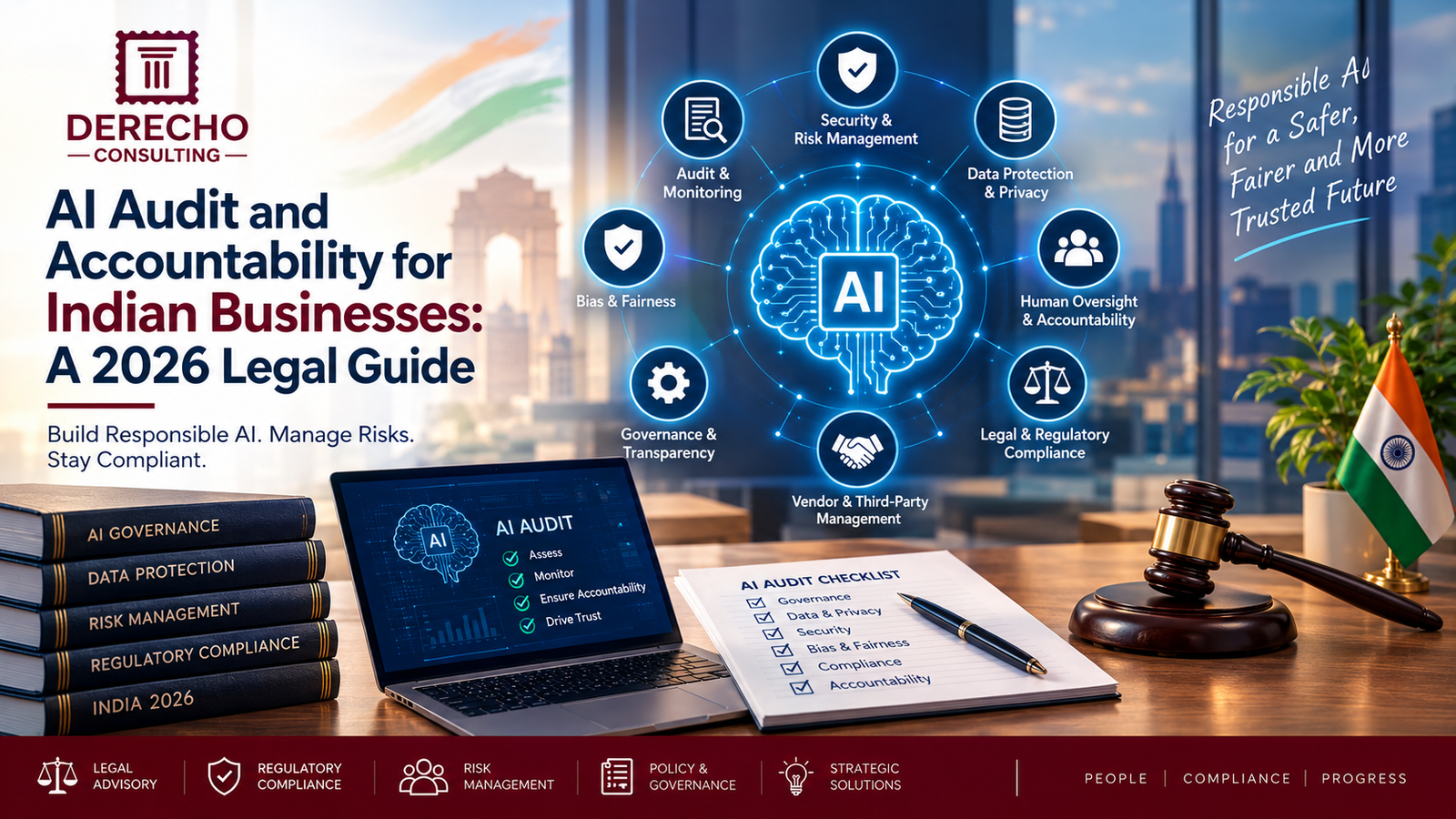
This guide explains AI Audit and Accountability for Indian Businesses, including AI risk assessment, governance, data protection, security, transparency, human oversight, vendor management, documentation, monitoring, incident response, and practical compliance considerations for 2026.
Why AI Audit Matters
AI systems can affect customers, employees, business decisions, financial outcomes, and operational processes. Without appropriate oversight, organisations may not know whether an AI system is producing reliable results, using data appropriately, or creating legal and operational risks.
Understanding AI Audit can help businesses:
- Identify AI-related legal and operational risks.
- Review how AI systems are being used.
- Assess data and privacy practices.
- Evaluate cybersecurity controls.
- Monitor accuracy and reliability.
- Identify potential bias or unfair outcomes.
- Establish human oversight.
- Strengthen documentation and accountability.
- Assess third-party AI providers.
- Improve governance and compliance readiness.
IndiaAI’s responsible-AI work highlights accountability, human oversight, impact assessment, monitoring, due diligence, and auditability as important governance considerations.
An appropriately designed AI audit can therefore help businesses understand not only whether an AI system works, but also whether it is being used in a legally and operationally responsible manner.
Key Areas of AI Audit and Accountability
1. AI System Inventory and Risk Classification
The first step in an AI Audit is identifying which AI systems the organisation uses and determining their level of risk.
The review may include:
- AI applications.
- Machine-learning models.
- Generative AI tools.
- AI-powered decision systems.
- Internal AI assistants.
- Third-party AI platforms.
- AI APIs.
- Automated workflows.
- AI-enabled products and services.
Businesses should document what each system does, who owns it, what information it processes, what decisions it influences, and what consequences could result from failure.
2. Purpose and Governance
Every AI system should have a clearly defined business purpose.
The review may consider:
- Intended use.
- Permitted use.
- Prohibited use.
- Business owner.
- Technical owner.
- Compliance responsibility.
- Approval process.
- Risk classification.
- Review frequency.
Clear ownership makes it easier to determine who is responsible for monitoring an AI system and responding when problems arise.
3. Data Protection and Privacy
AI systems can process significant quantities of personal and business information. An audit should therefore examine whether data is collected, used, stored, shared, and protected appropriately.
The review may include:
- Personal data.
- Training data.
- Customer information.
- Employee information.
- Data sources.
- Data retention.
- Third-party data processors.
- Data-sharing arrangements.
- Security controls.
- Privacy notices.
The Digital Personal Data Protection Rules, 2025 were notified by MeitY on 14 November 2025, with a phased commencement structure under the notified rules.
Businesses using AI to process personal data should therefore assess their data-governance practices against applicable data-protection requirements.
4. AI Security and Cybersecurity
AI systems can introduce security weaknesses involving models, APIs, data pipelines, external integrations, credentials, and connected applications.
An AI Audit should consider:
- Authentication.
- Authorisation.
- API security.
- Model access.
- Prompt security.
- Input validation.
- Output controls.
- Vulnerability management.
- Logging.
- Incident response.
- Third-party security.
CERT-In published a Blueprint for Reducing Exposure and Defending Against AI-Assisted Vulnerabilities Exploitation in Digital Infrastructure in May 2026, showing the growing importance of AI-specific cybersecurity risk management.
5. Accuracy and Reliability
Businesses should evaluate whether AI systems perform consistently enough for their intended purpose.
The audit may examine:
- Accuracy.
- Error rates.
- Hallucinations.
- False positives.
- False negatives.
- Model drift.
- Output consistency.
- Quality-control procedures.
- Testing results.
Higher-risk systems should receive stronger validation and monitoring before they are relied upon for important business decisions.
6. Bias and Fairness
AI systems can produce different outcomes for different groups depending on their data, design, objectives, and deployment environment.
Businesses should consider:
- Bias testing.
- Data quality.
- Training-data limitations.
- Disparate outcomes.
- Sensitive attributes.
- Human review.
- Corrective procedures.
- Documentation of testing.
An audit should determine whether the organisation has identified and appropriately managed material fairness risks associated with a particular AI use case.
7. Transparency and Explainability
Users, employees, customers, regulators, and other stakeholders may need to understand how an AI system is being used and, in some situations, how it contributes to an outcome.
The review may include:
- AI-use disclosures.
- Decision explanations.
- Documentation.
- Model limitations.
- User notices.
- Internal accountability.
- Escalation procedures.
IndiaAI’s responsible-AI material identifies transparency and explainability as important principles and links accountability to human oversight, impact assessment, monitoring, due diligence, and auditability.
8. Human Oversight and Accountability
AI should not be treated as an independent substitute for organisational responsibility.
An audit should identify:
- Who supervises the AI system.
- Who approves its use.
- Who reviews outputs.
- Who handles exceptions.
- Who can override the system.
- Who investigates failures.
- Who reports incidents.
- Who is accountable for outcomes.
Human oversight becomes particularly important where AI influences employment, financial decisions, customer outcomes, safety, compliance, or other consequential activities.
9. Intellectual Property and Confidential Information
AI systems can create intellectual-property and confidentiality risks through both inputs and outputs.
The review may include:
- Copyrighted training material.
- Proprietary data.
- Source code.
- Trade secrets.
- Third-party content.
- AI-generated outputs.
- Software licences.
- Vendor rights.
- Confidentiality obligations.
Businesses should document what information can be provided to an AI system and what categories of information are prohibited.
10. Third-Party AI Vendors
Many Indian businesses rely on external AI providers rather than building their own models.
An AI Audit should review:
- Vendor contracts.
- Data-processing terms.
- Security commitments.
- Data retention.
- Sub-processors.
- Intellectual-property terms.
- Confidentiality.
- Incident notification.
- Audit rights.
- Business continuity.
- Service termination and data deletion.
This helps organisations understand where responsibility lies when an external AI service fails or creates a legal or security issue.
11. Monitoring and Ongoing Testing
An AI audit should not be treated as a one-time exercise.
Businesses should establish ongoing monitoring for:
- Model performance.
- Security events.
- Unexpected outputs.
- User complaints.
- Data-quality changes.
- Model changes.
- New integrations.
- Regulatory developments.
- Material incidents.
India’s earlier AI-governance work has also emphasised that AI governance cannot be treated as a one-time exercise and should be reviewed periodically as technology and experience develop.
12. Documentation and Audit Trails
A strong AI governance framework should maintain evidence of how AI systems are managed.
Documentation may include:
- AI inventories.
- Risk assessments.
- Approval records.
- Model documentation.
- Data maps.
- Security assessments.
- Testing reports.
- Vendor reviews.
- Incident records.
- Corrective actions.
- Audit findings.
- Management approvals.
Good documentation can help demonstrate accountability and make future legal, regulatory, and internal reviews more efficient.
Common AI Audit and Accountability Risks for Indian Businesses
Businesses may face AI Audit and accountability risks due to:
- No central inventory of AI systems.
- Unclear ownership of AI tools.
- Use of unapproved AI applications.
- Weak data-governance controls.
- Inadequate privacy assessments.
- Insufficient cybersecurity measures.
- Lack of human oversight.
- Poor monitoring of AI outputs.
- Inadequate bias or fairness testing.
- Unclear vendor responsibilities.
- Weak intellectual-property controls.
- Incomplete documentation.
- Failure to review AI-generated decisions.
- No formal incident-response procedure.
- Failure to reassess AI systems after material changes.
These risks can become more significant when AI systems are embedded into customer-facing or business-critical processes.
Best Practices for AI Audit and Accountability
Indian businesses should consider the following practices:
- Maintain a central AI inventory.
- Classify AI systems according to risk.
- Assign clear business and technical ownership.
- Define permitted and prohibited uses.
- Conduct periodic AI risk assessments.
- Review personal-data processing.
- Test AI security and vulnerabilities.
- Evaluate accuracy and reliability.
- Assess material bias and fairness risks.
- Maintain meaningful human oversight.
- Review third-party AI contracts.
- Monitor AI systems after deployment.
- Maintain detailed audit trails.
- Establish AI incident-response procedures.
- Periodically update AI governance policies.
India’s responsible-AI work supports an approach based on internal governance, accountability, impact assessment, monitoring, due diligence, and auditability rather than relying only on prescriptive technical requirements.
A practical governance programme can therefore help businesses build accountability into the entire AI lifecycle.
2026 AI Audit and Accountability Considerations
AI Audit is becoming increasingly relevant in 2026 as Indian businesses move from experimentation toward wider operational use of AI.
MeitY’s 2026 activity includes the establishment of the AI Governance and Economic Group, while IndiaAI continues to publish and develop material around responsible AI, accountability, governance, and auditability.
CERT-In has also issued 2026 guidance addressing AI-assisted vulnerability exploitation and frontier-AI-driven cyber risks, indicating that AI security and governance are becoming more closely connected.
Businesses should therefore pay particular attention to:
- AI system inventories.
- AI risk classification.
- AI governance committees.
- Data-protection assessments.
- Model and application security.
- AI-assisted cyber threats.
- Human oversight.
- Audit trails.
- Third-party AI governance.
- AI incident response.
- Periodic model reviews.
- Board-level reporting.
- Regulatory-change monitoring.
The Digital Personal Data Protection Rules, 2025 also provide a phased implementation framework for India’s data-protection regime, increasing the importance of reviewing AI systems that process digital personal data.
Businesses should therefore treat AI accountability as an ongoing governance function rather than a one-time compliance exercise.
How Derecho Consulting Can Help
Derecho Consulting can help Indian businesses develop and strengthen AI Audit and accountability frameworks through AI governance assessments, risk classification, data-protection reviews, technology-contract analysis, third-party AI due diligence, cybersecurity legal advisory, policy development, audit-readiness assessments, and compliance documentation.
A proactive approach can help businesses:
- Build an AI governance framework.
- Identify high-risk AI use cases.
- Review AI policies and approval processes.
- Assess data and privacy risks.
- Review vendor contracts.
- Strengthen human-oversight mechanisms.
- Develop AI audit checklists.
- Establish documentation and reporting procedures.
- Prepare for internal and regulatory reviews.
Derecho Consulting can also assist businesses in periodically reviewing their AI governance programmes as regulatory expectations, AI capabilities, and business use cases evolve.
Conclusion
AI Audit and Accountability for Indian Businesses is becoming an important part of responsible technology governance. As AI systems increasingly influence operational, commercial, customer, and organisational decisions, businesses need clear processes to identify risks, assign responsibility, monitor performance, protect data, and respond to failures.
An effective AI audit should look beyond technical performance. It should consider governance, data protection, cybersecurity, transparency, human oversight, intellectual property, vendor relationships, documentation, and the legal and operational consequences of AI deployment.
By creating a central AI inventory, conducting periodic risk assessments, implementing appropriate controls, maintaining audit trails, reviewing third-party providers, and establishing clear accountability, businesses can strengthen their approach to AI governance.
A proactive and well-documented approach to AI Audit can help Indian businesses improve accountability, reduce legal and operational risks, strengthen trust, and support responsible AI adoption in 2026 and beyond.