
Introduction
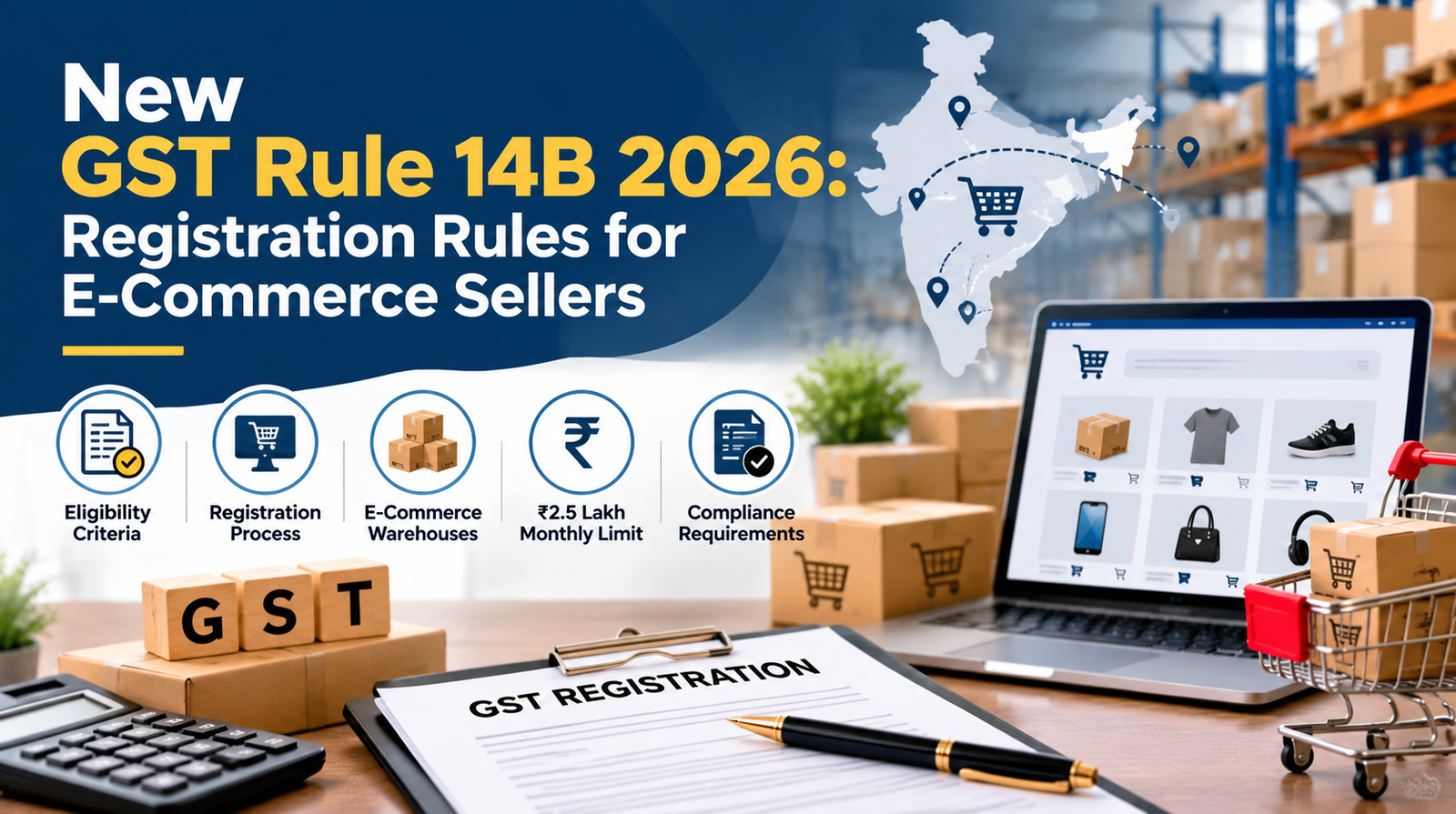
GST Rule 14B 2026 introduces a simplified registration mechanism for eligible small businesses selling goods through e-commerce platforms in India. Effective from 1 November 2026, the new rule allows certain sellers to obtain GST registration in states where they do not have a physical business presence.
The Central Government introduced this provision through Notification No. 05/2026–Central Tax, dated 26 October 2026. It amends the Central Goods and Services Tax (CGST) Rules, 2017, and aims to make interstate e-commerce operations easier for small sellers.
Under this mechanism, eligible sellers can declare an approved e-commerce operator’s warehouse as their principal place of business in another state, subject to specified conditions.
These changes are particularly relevant to online retailers, small businesses, marketplace sellers and entrepreneurs planning to expand their operations across India.
This article explains the new registration rules, eligibility requirements, application process and compliance responsibilities for e-commerce sellers.
1. What Is GST Rule 14B 2026?
GST Rule 14B is a new provision under the CGST Rules, 2017. It creates an optional registration facility for eligible suppliers selling goods through electronic commerce operators.
Previously, businesses generally needed to establish a principal place of business in a state to obtain GST registration there. This could create additional costs for small sellers who wanted to store and distribute products through warehouses operated by e-commerce platforms.
The new provision addresses this challenge.
Under GST Rule 14B 2026, an eligible seller who already holds GST registration in a home state can apply for another registration in a state where the seller has no physical presence.
For this purpose, the seller can declare the warehouse of an eligible e-commerce operator as the principal place of business, subject to the operator’s consent and other prescribed conditions.
The facility is intended to simplify interstate selling and reduce the need for small businesses to establish separate physical premises in every state.
2. Why Was the New GST Rule Introduced?
Selling products across multiple states can create additional GST registration and operational requirements.
Small online sellers may use e-commerce warehouses to store products closer to customers. However, maintaining a separate physical business location in every state can increase operating costs.
The new rule aims to address these difficulties.
The main objectives include:
- Simplifying GST registration for eligible online sellers.
- Supporting small businesses that sell through e-commerce platforms.
- Reducing the need to establish physical premises in every state.
- Encouraging interstate trade through digital marketplaces.
- Improving ease of doing business.
- Making warehouse-based business operations easier to manage.
By introducing this facility, the government aims to help eligible sellers expand their market reach without unnecessary physical infrastructure.
3. Who Is Eligible Under GST Rule 14B 2026?
Not every online seller can use this registration facility. Businesses must satisfy the conditions specified under the new rule.
The important eligibility requirements include:
Existing GST registration
The seller must already have a regular GST registration in a state where the business has a physical presence.
The registration must be obtained under the prescribed registration procedure.
No physical presence in the additional state
The seller must not have a physical presence in the state or union territory where the additional registration is requested.
The seller must also satisfy the applicable conditions relating to existing GST registrations in that state.
Sales through eligible e-commerce operators
The seller must intend to supply goods through an e-commerce operator required to collect tax at source under Section 52 of the CGST Act, 2017.
The facility is specifically intended for eligible supplies of goods. It should not be treated as a general registration route for service providers.
Monthly tax liability limit
The total output tax liability on supplies made to registered persons, excluding persons registered under the same PAN, must not exceed ₹2.5 lakh per month.
The calculation includes:
- Central GST (CGST).
- State GST (SGST) or Union Territory GST (UTGST).
- Integrated GST (IGST).
This threshold is an important eligibility condition under the new mechanism.
E-commerce operator consent
The selected e-commerce operator must consent to the seller declaring its warehouse as the principal place of business.
Without the required consent, the application cannot proceed through the prescribed mechanism.
4. How Does the E-Commerce Warehouse Registration Process Work?
One of the key features of GST Rule 14B is the ability to use an e-commerce operator’s warehouse as the principal place of business.
This can help eligible sellers manage interstate operations without setting up a separate physical office or warehouse.
The registration process generally involves the following steps:
Step 1: Verify existing GST registration
The seller should confirm that an active regular GST registration is available in the home state.
Step 2: Identify the destination state
The seller should identify the state where additional GST registration is required and confirm that the eligibility conditions are satisfied.
Step 3: Select an eligible e-commerce operator
The seller must select an e-commerce operator that is required to collect tax at source under Section 52.
Step 4: Obtain warehouse consent
The seller must obtain the operator’s consent to declare its warehouse as the principal place of business.
Step 5: Submit the registration application
The application must be submitted electronically in FORM GST REG-01 through the GST common portal, with the required details and declarations.
Step 6: Complete authentication and verification
The applicant must complete the prescribed Aadhaar authentication and document verification requirements.
Subject to the applicable conditions and successful system validation, registration can be granted through the prescribed process.
5. What Is the ₹2.5 Lakh Monthly Tax Liability Condition?
The ₹2.5 lakh threshold is one of the most important conditions under GST Rule 14B.
Eligible sellers must ensure that their total output tax liability on supplies made to registered persons, other than persons registered under the same PAN, does not exceed ₹2.5 lakh per month.
This includes the applicable CGST, SGST or UTGST and IGST components.
Businesses should understand that this is a tax liability threshold, not a general monthly sales turnover limit.
For example, a seller should not assume that monthly sales of ₹2.5 lakh automatically satisfy the condition. The relevant tax liability must be calculated based on the specified supplies and applicable GST rates.
Stock transfers between distinct persons are excluded from the relevant calculation as provided under the scheme.
What businesses should do
- Monitor monthly output tax liability.
- Maintain accurate sales and invoice records.
- Identify supplies made to registered customers.
- Review transactions between registrations under the same PAN.
- Reassess eligibility if business operations expand.
Regular monitoring can help sellers identify potential compliance issues before they affect their registration.
6. What Are the Responsibilities of E-Commerce Operators?
E-commerce operators play an important role in the new registration mechanism.
Their consent is necessary when a seller wants to declare an operator’s warehouse as the principal place of business.
The operator must also meet the applicable requirements under the GST framework.
Important responsibilities include:
- Providing consent for the proposed warehouse address.
- Supporting the prescribed registration process.
- Providing an authorised representative in the relevant state or union territory, as required.
- Cooperating with information requests concerning registered sellers.
- Maintaining the applicable GST registration and tax collection compliance.
The seller and e-commerce operator should coordinate their documentation and warehouse details to avoid delays during registration.
7. Documents and Verification Requirements
Businesses should prepare the required information before applying for registration under GST Rule 14B.
The application and verification process may require:
- Existing home-state GSTIN.
- PAN details of the business.
- Details of the selected e-commerce operator.
- Warehouse address and relevant particulars.
- E-commerce operator consent.
- Business and authorised signatory details.
- Prescribed declarations and supporting documents.
- Aadhaar authentication and biometric verification, where applicable.
Applicants should also ensure that their existing registration details are accurate.
Completing the prescribed verification requirements is important for successful registration.
8. Important Compliance Responsibilities After Registration
Obtaining additional GST registration is only the first step. Sellers must continue to meet their GST responsibilities after registration.
Businesses should pay attention to the following areas:
GST return filing
Maintain accurate records and file applicable GST returns within the prescribed deadlines.
Invoice management
Issue tax invoices in accordance with the applicable GST requirements and maintain proper transaction records.
Input Tax Credit
Review ITC eligibility and ensure that credit claims are supported by valid documents and applicable provisions.
E-commerce transactions
Reconcile sales made through e-commerce operators with platform statements and GST records.
Warehouse documentation
Maintain updated warehouse details and ensure that the declared business address remains valid with the operator’s consent.
Registration changes
Inform the GST department through the prescribed process when relevant business or warehouse details change.
Businesses should also monitor their eligibility conditions and take appropriate action if they no longer satisfy the requirements.
9. Practical GST Compliance Checklist for Online Sellers
The following checklist can help online sellers prepare for the new registration mechanism.
- Confirm that the business has an active regular GST registration in its home state.
- Check eligibility for registration in the additional state.
- Verify that the business supplies goods through an eligible e-commerce operator.
- Obtain consent for declaring the operator’s warehouse as the principal place of business.
- Check the ₹2.5 lakh monthly output tax liability condition.
- Prepare PAN, GSTIN and warehouse details.
- Complete the prescribed Aadhaar authentication and verification.
- Submit the application through FORM GST REG-01.
- Maintain accurate sales invoices and transaction records.
- Reconcile e-commerce platform statements with GST returns.
- Monitor changes in warehouse and business details.
- Review GST compliance regularly.
Following these steps can help businesses manage their registration requirements more effectively.
10. How Derecho Consulting Can Help
Understanding new GST provisions and applying them to business operations can be challenging, particularly for businesses selling through multiple online marketplaces.
Derecho Consulting supports organisations with GST compliance, tax advisory, regulatory guidance and documentation reviews.
Our support can help businesses:
- Understand the eligibility requirements under GST Rule 14B.
- Review existing GST registration arrangements.
- Assess monthly output tax liability.
- Identify applicable documentation requirements.
- Review e-commerce and warehouse-related compliance.
- Understand Input Tax Credit and return filing responsibilities.
- Identify potential GST compliance gaps.
With professional guidance, businesses can better understand the new requirements and prepare their operations for regulatory changes.
Conclusion
The introduction of GST Rule 14B 2026 is an important development for eligible small sellers operating through e-commerce platforms in India.
The new mechanism provides an opportunity to obtain GST registration in additional states by declaring an eligible e-commerce operator’s warehouse as the principal place of business, subject to prescribed conditions.
However, businesses must carefully review their eligibility, monthly output tax liability, warehouse consent and registration requirements before applying.
Understanding the new provisions can help online sellers expand their operations, manage interstate transactions and maintain appropriate GST records.
For businesses planning to use this facility, reviewing the applicable rules and seeking professional guidance can make the registration and compliance process easier.
Disclaimer: This article is intended for general informational purposes only and does not constitute legal or tax advice. Businesses should refer to Notification No. 05/2026–Central Tax, the CGST Act, the CGST Rules and applicable GST instructions before making registration or compliance decisions.