
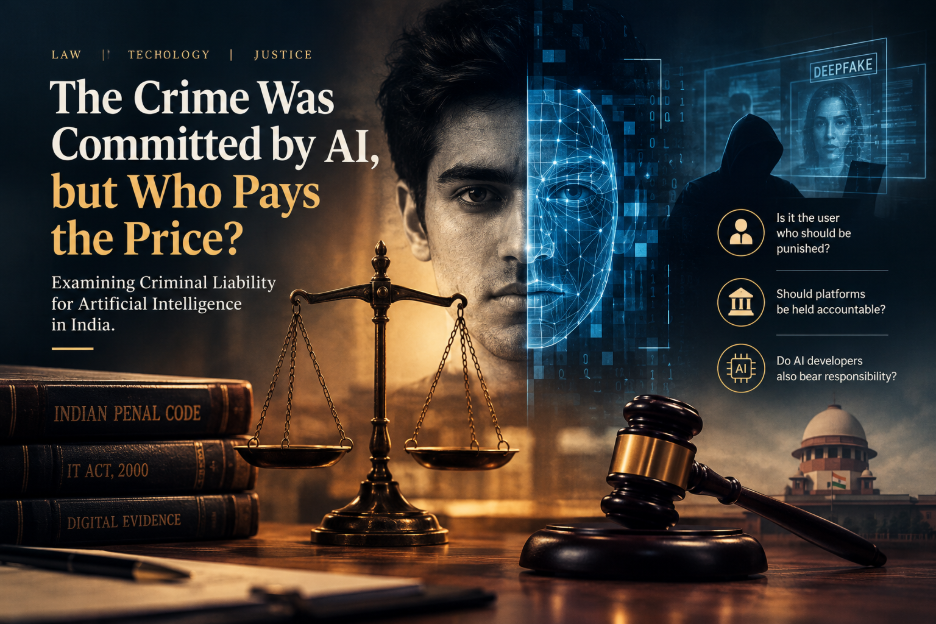
An AI-generated crime in India raises a question the law has not fully answered yet. Who goes to court when software commits the offence? A deepfake can defame a person, a chatbot can cheat a customer, and an algorithm can leak private data. None of these tools can stand trial. So the law has to find a human or a company to hold responsible. Here is how Indian law handles an AI-generated crime in India today, and where the gaps still sit.
Why an AI-Generated Crime in India Is Hard to Prosecute
Criminal law rests on two ideas. The first is the guilty act, which lawyers call actus reus. The second is the guilty mind, called mens rea. Both assume a human actor.
AI breaks that assumption. A machine has no legal personality. It cannot form intent, and it cannot be punished. Consequently, courts cannot treat an AI system as the accused in the usual sense.
India also has no standalone AI law yet. As a result, an AI-generated crime in India falls back on older statutes. These laws were written for people, not for software.
The Laws That Apply to an AI-Generated Crime in India
Three sets of rules do most of the work today.
The Bharatiya Nyaya Sanhita, 2023. This code replaced the Indian Penal Code in July 2024. It covers cheating, defamation, forgery, and organised crime. Prosecutors apply these offences to the human behind the AI. For example, Section 111 on organised crime may apply to large disinformation campaigns.
The Information Technology Act, 2000. This law covers identity theft, cheating by impersonation, privacy violations, and obscene content. Sections 66C, 66D, 66E, 67, and 67A are the ones prosecutors reach for most often in deepfake cases.
The IT Rules, as amended in 2026. The government amended these rules on 10 February 2026, and they took effect on 20 February 2026. They created India’s first binding, AI-specific compliance regime. The rules target “synthetically generated information,” which means realistic AI-made audio, images, and video.
What the 2026 IT Rules Changed
The 2026 amendments mainly place duties on platforms. Any intermediary that lets users create or share synthetic content must now take active steps. It must use reasonable technical tools to block unlawful content. It must also label other AI-made content and embed permanent metadata, including a unique identifier.
The rules name several banned categories. These include child sexual abuse material, non-consensual intimate images, and false electronic records. They also include content that falsely depicts a real person or event in order to deceive.
The penalty for non-compliance is significant. A platform that fails these duties can lose its safe harbour protection. Therefore, it can become liable for harmful content that users post.
Who Is Legally Responsible for an AI-Generated Crime in India?
No single answer fits every case. Liability depends on who did what. Still, Indian law points to four possible targets.
The user. A person who prompts an AI to create a fake video of someone, or to draft a phishing message, commits the offence. The AI is only a tool. Prosecutors charge the user under the BNS and the IT Act, just as they would for any forged document.
The developer or deployer. A company that builds or runs an AI system may face scrutiny if it acts negligently. Section 85 of the IT Act allows liability for company officers where the offence happened with their consent, connivance, or negligence.
The platform. Intermediaries now carry explicit duties under the 2026 rules. If a platform ignores them, it loses its legal shield. That makes platforms a real target in deepfake cases.
The AI itself. This option does not exist. Indian law does not recognise AI as a legal person, so it cannot be an accused.
The Gaps That Still Remain
The current system leaves real holes. India lacks a law that specifically assigns liability for AI-generated harm. Legal experts note that existing statutes, including the IT Act, contract law, and consumer law, were never designed for generative AI.
One open question is how courts will classify AI platforms. In May 2026, the Calcutta High Court heard IndiaMART’s case against OpenAI. The court considered whether a chatbot counts as an “intermediary” or an “originator” under the IT Act. That distinction matters enormously, because intermediaries enjoy safe harbour while originators do not.
Another gap involves intent. If an AI system acts in a way no human predicted, proving a guilty mind becomes very hard. Courts may lean on negligence or foreseeability instead. However, no settled rule exists yet.
What Is Coming Next
Change appears likely. A senior MeitY official reportedly said on 9 July 2026 that drafting of standalone AI regulation will begin soon. The IT Minister also said in June 2026 that India needs a new AI law. Meanwhile, no draft or timeline has been shared publicly.
In the meantime, the government relies on its November 2025 India AI Governance Guidelines. These set out seven ethical principles and push a pro-innovation approach. They are guidance, not binding law.
How This Connects to India’s Wider Crackdown on Digital Fraud
India is tightening several areas of technology law at once. Exam fraud offers a useful comparison. The government has moved to raise penalties and fast-track trials under its public examinations law, because weak enforcement undermined the original rules. The same lesson applies to AI crime. A strong statute means little without fast, consistent enforcement. For a closer look at how India is handling that problem in a different field, read our full guide to India’s anti-cheating law and exam paper leaks.
Final Thought
An AI-generated crime in India does not leave victims without options, but the path is patchy. Today, the law pins responsibility on humans and companies, not on the software. Users face charges under the BNS and the IT Act. Platforms face loss of safe harbour under the 2026 rules. Developers face scrutiny where negligence is shown. The real gap lies in cases where no human intended the harm, and a future AI law will have to settle that. Until then, anyone who builds, deploys, or uses AI should assume that the human behind the machine carries the legal risk.
This article gives general information, not legal advice. Consult a qualified lawyer about any specific situation.