
Introduction
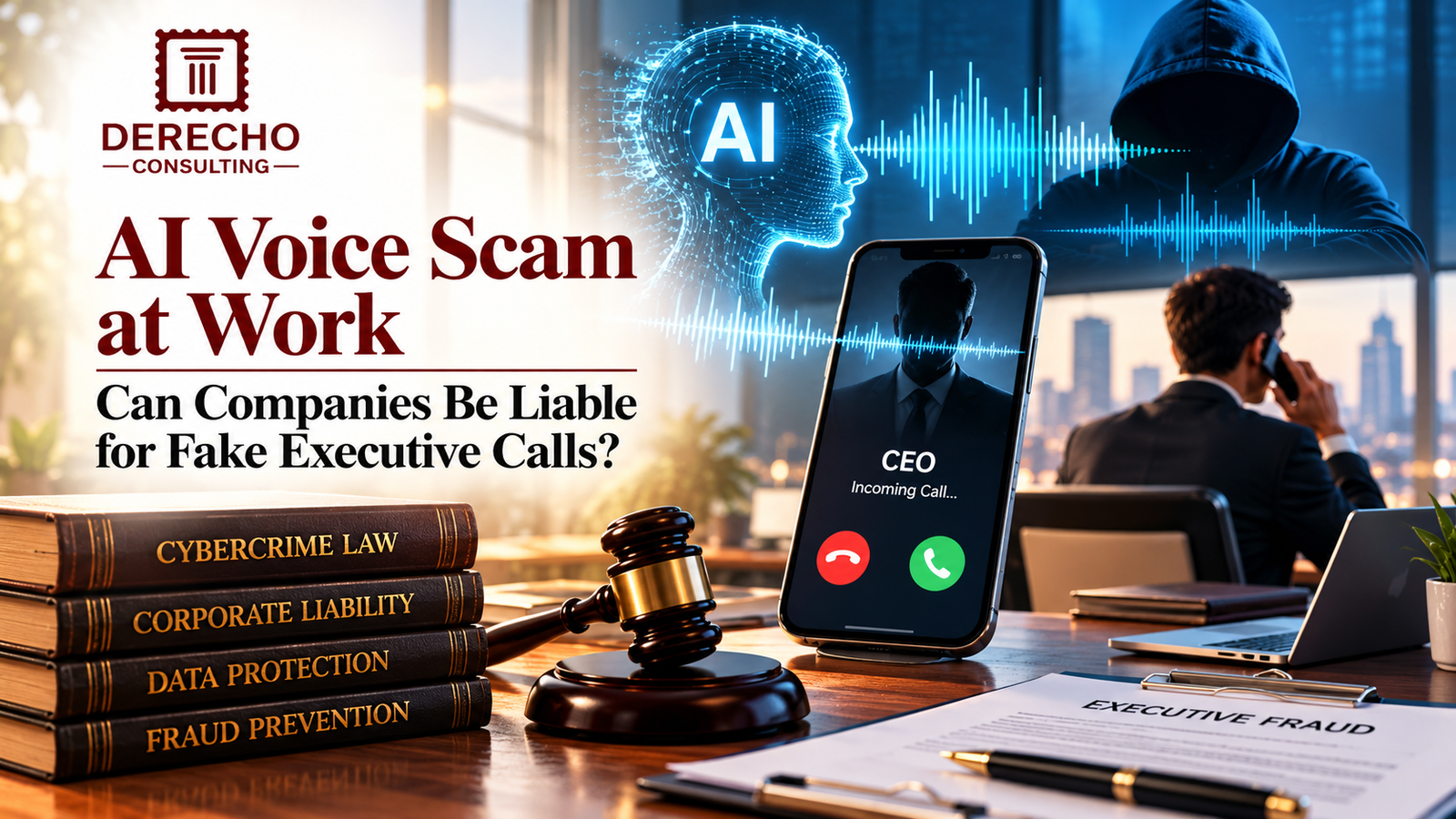
AI Voice Scam Liability is becoming an important legal and cybersecurity concern for businesses as artificial intelligence makes voice cloning more sophisticated. Criminals can use AI-generated voices to impersonate CEOs, CFOs, directors or other senior executives and pressure employees into transferring money, sharing confidential information or taking unauthorised actions.
Unlike traditional fraud, AI voice scams can make a fraudulent instruction sound highly convincing. An employee may believe that they are speaking directly with a senior executive, particularly when the call is supported by a convincing email, WhatsApp message or other digital communication.
For businesses, the consequences can extend beyond financial losses. A successful AI voice scam may raise questions about internal controls, cybersecurity practices, employee responsibilities, data protection, corporate governance and the company’s response to the incident.
Understanding AI Voice Scam Liability is therefore important for companies that want to protect their financial assets, confidential information and business operations from increasingly sophisticated impersonation fraud.
What Is an AI Voice Scam?
An AI voice scam involves the use of artificial intelligence or voice-cloning technology to imitate another person’s voice. Criminals may obtain voice recordings from public interviews, social media videos, online meetings, presentations or other publicly accessible sources.
The cloned voice can then be used to make a fraudulent call appear to come from a trusted person.
In a workplace environment, an attacker may impersonate a senior executive and instruct an employee to:
- Transfer company funds
- Change payment details
- Share confidential information
- Provide access credentials
- Approve an urgent transaction
- Download a file or application
- Bypass normal approval procedures
The effectiveness of these scams often depends on urgency, authority and trust rather than technology alone.
How Do Fake Executive Calls Work?
A fake executive call can involve several stages.
1. Gathering Information
The attacker first collects information about the company and its executives. Public websites, social media accounts, interviews and professional profiles can provide useful information.
2. Creating a Voice Clone
The attacker uses AI technology to create a synthetic voice that resembles the targeted executive.
3. Targeting an Employee
Finance, accounts, procurement or administrative employees may be targeted because they can approve payments or access sensitive business information.
4. Creating Urgency
The caller may claim that the transaction is confidential, time-sensitive or required immediately.
5. Requesting an Action
The employee may be instructed to transfer money, change account information or share sensitive data.
6. Preventing Verification
The attacker may discourage the employee from checking with another person by claiming that the matter is confidential or urgent.
This combination of AI-generated voice technology and social engineering can make traditional fraud-prevention procedures less effective if employees rely only on voice recognition.
AI Voice Scam Liability: Can Companies Be Held Responsible?
AI Voice Scam Liability depends on the circumstances of the incident and does not automatically arise simply because an employee was deceived by a fake voice.
The legal position may depend on factors such as:
- The company’s internal controls
- The nature and value of the transaction
- Employee authority
- Verification procedures
- Cybersecurity measures
- Applicable contractual obligations
- Data protection practices
- The company’s response after discovering the fraud
A company that maintains strong verification procedures may be in a better position to demonstrate that reasonable precautions were taken.
However, if significant transactions can be completed solely on the basis of an unverified phone call or message, the incident may expose weaknesses in the company’s internal control environment.
When Could an AI Voice Scam Become a Corporate Governance Issue?
AI voice fraud can become a corporate governance concern when it reveals weaknesses in financial controls, risk management or management oversight.
For example, companies should examine whether employees are permitted to approve large transactions without independent verification. They should also determine whether senior management and the board have considered AI-enabled impersonation as part of the organisation’s fraud and cybersecurity risk framework.
Businesses should establish clear procedures for unusual financial instructions and ensure that employees understand when additional approval or verification is required.
AI Voice Scam Liability and Employee Responsibilities
Employees are often the final point of contact in an executive impersonation scam. For this reason, companies should provide clear guidance on how employees should respond to unusual requests.
Employees should independently verify:
- Urgent payment instructions
- Changes to bank account details
- Requests for confidential information
- Unusual instructions from senior executives
- Requests that bypass normal approval procedures
- Instructions received through unfamiliar communication channels
A familiar voice should not be treated as sufficient proof of identity.
For high-value or sensitive transactions, companies should use an independent verification method, such as contacting the executive through a previously verified telephone number or following a documented approval process.
What Should Companies Do After an AI Voice Scam?
A quick and organised response can help reduce further losses and preserve important evidence.
Stop or Recall the Transaction
If money has already been transferred, the company should immediately contact the relevant bank or financial institution to determine whether the transaction can be stopped or recalled.
Preserve Evidence
Companies should preserve relevant call records, messages, emails, transaction details, device information and other evidence that may help identify the source of the attack.
Investigate the Incident
The company should determine how the attacker obtained information about the executive and employee and how the fraudulent instruction was delivered.
Assess Data Exposure
If confidential, personal or financial information was disclosed, the company should assess whether additional data protection or incident-response measures are required.
Report the Incident
Depending on the circumstances, the company should consider reporting the incident to the appropriate law-enforcement or regulatory authorities.
Review Internal Controls
Following an incident, the company should review its payment approvals, authentication procedures, access controls and employee verification processes.
How Can Companies Prevent AI Voice Scams?
Technology alone may not be enough to prevent sophisticated impersonation fraud. Companies should combine technical security measures with strong internal processes.
Important safeguards include:
- Multi-factor authentication
- Dual approval for high-value payments
- Independent verification of executive instructions
- Callback procedures using trusted contact information
- Strong access controls
- Employee cybersecurity training
- Fraud-awareness programmes
- Payment verification protocols
- Monitoring for unusual transactions
- Clear incident-response procedures
Companies should also ensure that employees understand that urgency should never replace proper verification.
AI Voice Scams and Data Protection
AI voice scams can involve the collection and misuse of personal and business information.
Attackers may gather an executive’s name, job position, voice recordings, photographs, email address and other information before attempting an impersonation.
Businesses should therefore review how sensitive information is exposed online and internally. Access controls, data minimisation and appropriate security measures can help reduce the information available to attackers.
Companies should also consider whether information used to create or support an impersonation was obtained through compromised systems, unauthorised access or other unlawful means.
What Should Indian Businesses Do in 2026?
Indian businesses should treat AI-enabled impersonation as part of their wider cybersecurity, fraud-prevention and corporate governance framework.
Companies should regularly review whether existing controls are capable of addressing realistic AI-generated voices and other forms of synthetic media.
Businesses should also establish clear escalation procedures so employees know exactly what to do when they receive unusual or high-value instructions.
A practical approach should include:
- Regular fraud-risk assessments
- AI-related cybersecurity awareness
- Strong executive verification procedures
- Payment approval controls
- Employee training
- Data security reviews
- Incident-response planning
- Periodic testing of internal controls
- Management oversight of emerging technology risks
AI Voice Scam Compliance Checklist
Companies should review the following areas:
- Executive identity verification
- Payment approval procedures
- Multi-factor authentication
- Employee cybersecurity training
- Bank-account change verification
- Access-control policies
- Data protection procedures
- Incident-response plans
- Fraud reporting mechanisms
- Evidence preservation procedures
- Third-party cybersecurity risks
- Board and management oversight
Regularly testing these controls can help businesses identify weaknesses before attackers exploit them.
AI Voice Scam Liability: What Companies Should Review
Companies assessing AI Voice Scam Liability should look beyond the immediate financial loss.
They should review whether the organisation had appropriate safeguards, whether employees followed established procedures, whether sensitive information was adequately protected and whether the incident was handled appropriately.
A documented risk-management process can also help businesses demonstrate that AI-enabled fraud has been considered as part of their broader corporate risk framework.
How Derecho Consulting Can Help
AI-enabled fraud requires businesses to consider cybersecurity, legal, compliance and governance risks together.
Derecho Consulting can assist businesses with:
- AI and cybersecurity legal risk assessments
- Corporate fraud and compliance reviews
- Data protection assessments
- Internal control reviews
- Technology and cybersecurity compliance
- Incident-response planning
- Corporate governance advisory
- AI risk-management frameworks
- Legal and regulatory compliance strategies
A proactive legal and compliance review can help businesses identify weaknesses in their existing processes and develop stronger safeguards against AI-enabled fraud.
Conclusion
AI voice scams are changing the way criminals impersonate executives and manipulate employees. A convincing synthetic voice can make a fraudulent instruction appear genuine, but businesses can reduce the risk through independent verification, strong authentication, employee awareness and effective financial controls.
AI Voice Scam Liability will depend on the circumstances of each incident, including the company’s conduct, applicable legal requirements, contractual arrangements and the controls it had in place. Businesses should therefore avoid relying solely on voice recognition when authorising sensitive transactions.
As AI-generated impersonation becomes more sophisticated, companies should proactively strengthen their cybersecurity, fraud-prevention and governance processes. A structured approach can help businesses protect financial assets, confidential information and operations while reducing the legal and compliance risks associated with fake executive calls.